There is little doubt that Winnipeg Jets fans will quaff a few cold ones at Canada Life Centre over the next several months as the hockey club follows up on a President’s Cup-winning season that saw it finish as the NHL’s top regular season team in 2024–25.
While the team will hopefully give their fans in the stands plenty of on-ice reasons to celebrate, they may also want to raise a glass to toast the suds in their cup. True North Sports + Entertainment, the hockey club’s parent company, recently installed a new, state-of-the-art treatment system to clean the lines that supply those tasty suds to the more than 300 beer taps located throughout the downtown Winnipeg entertainment venue.
The system, known as Draught Guard, is manufactured by a Milwaukee-based company of the same name. It uses a proprietary water treatment technology originally developed for the oil and gas industry to manage mineral fouling and biological growth and is now in use at health-care facilities, power plants and Fortune 100 companies across North America.
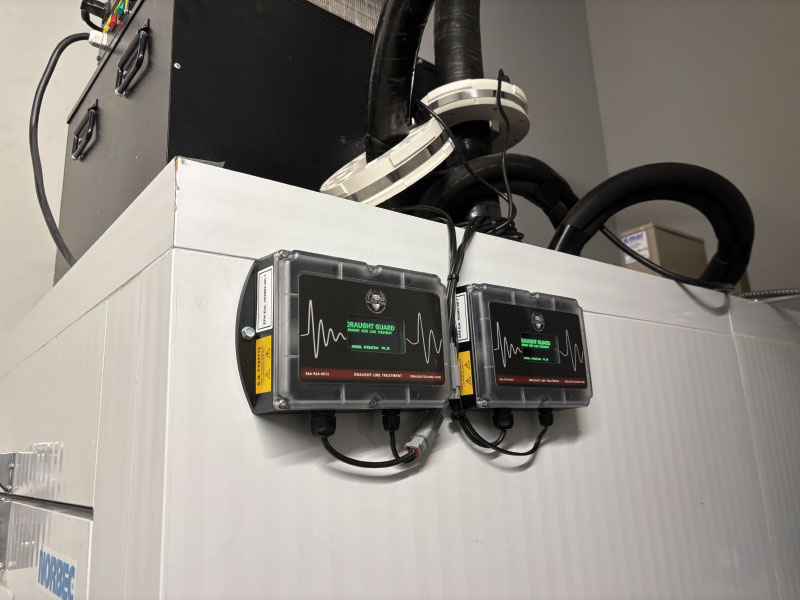
How it works is relatively simple. A control unit measuring five by seven inches connects to a signal transformer ring that is seven inches in diameter and wraps around the outside of up to 12 beer lines, which supply suds to the beer taps. The small unit emits a low-frequency radio signal throughout the entire line regardless of its length. The system then works in the background 24/7 to prevent the buildup of biofilm and calcium oxalate (beer stone) and provide protection of the product being served on tap.
What we do is we actually send that radio frequency into the beer itself. We use the conductivity of that beer to move the signal. That signal will follow the conductivity, the beer, the water, whatever is in that line, as far as it’s going.
Jackson Cosgriff, Draught Guard
Jackson Cosgriff, business development manager for the company, describes the Draught Guard unit as a “fancy a.m. radio” in terms of how it functions.
“What we do is we actually send that radio frequency into the beer itself. We use the conductivity of that beer to move the signal. That signal will follow the conductivity, the beer, the water, whatever is in that line, as far as its going,” he said. “Wherever there’s fluid, the signal will follow. That means downstream to the taps and the beer tower, and upstream to the keg as well. What that does is it makes it difficult for bacteria, biofilm, mould [and] mineral scale to actually adhere (inside the line). We’re putting a charge on all the particles that are in there and kind of making them behave. We make it difficult for that microbial activity to thrive and cling to the beer lines.”
Although the technology used in Draught Guard has been around for some time, it wasn’t until fairly recently that the parent company that developed it began to look at how it could be used in other industries, including the beer industry.
Draught Guard was launched in 2018, and soon after, the company began working with several major sports stadiums, breweries and brewing institutes to analyze and test how the product could work with draught beer. Several studies were conducted, including one commissioned by the American Society of Heating, Refrigerating and Air-Conditioning Engineers through the University of Pittsburgh that showed a 98 per cent reduction of biofilm. It remains the only non-chemical system to have passed to date.
Cosgriff and director of business development Kevin Brauer say the beauty of the Draught Guard system is that it can dramatically reduce the amount of time and money users spend on cleaning draught lines compared to the traditional method of flushing a caustic or alkaline chemical through the line using water and a recirculating pump. The chemical cleaning method requires users to clean their draught lines every two weeks.
By comparison, those same lines need only be cleaned every 12 weeks using the Draught Guard technology. That means far less beer has to be dumped (about 85 per cent less) when the lines need to be cleaned and staff can be deployed to other tasks. There’s also a huge sustainability component to Draught Guard, Brauer says. As the lines using the system only need to be chemically cleaned four times a year compared to 26 using more traditional methods, far less beer, chemicals and CO2 are being dumped into the sewer system.
Best of all, the radio frequency Draught Guard uses has no impact on the composition of the beer going through the draught lines. If anything, it helps to preserve the original flavour profile of the beer that is being poured. “Draught Guard will not have any effect on the inherent flavour or nature of that beer. There’s no vibration. There’s no actual changing of the technical chemistry of the beer,” Cosgriff said, adding that a draught system’s taps and couplers, which attach to kegs, must still be routinely cleaned since they come into contact with oxygen. “Basically, it allows the beer to taste more like itself and not become degraded because of biofilm and beer stone that might clog the line.”
Chris Milton, senior manager of logistics and procurement for True North, says his company first learned about Draught Guard during a conversation with the food and beverage team at Madison Square Garden in New York. They did some follow-up investigations and were so impressed by what they learned they hired Draught Guard to install 32 units at Canada Life Centre in July 2025.
“Having over 300 beer taps throughout the building, we thought it would be the perfect addition to our already extensive beer line cleaning schedule,” he said. “Cleaning the beer lines is a process all in itself, and by installing Draught Guard, we maintain the highest quality possible when it comes to the product we are serving our guests. We are always looking to enhance and elevate our patrons’ experience for every event they attend, and we are excited to say that our draft beer system is continuing that process even after the Winnipeg Jets have left the ice, the concert has loaded out, the staff have gone home and the lights are turned off.”
Canada Life Centre is one of two high-profile Canadian sports venues to turn to Draught Guard. The company has also been working with the team at Rogers Centre, home to Major League Baseball’s Toronto Blue Jays, where its system has been installed at a growing number of bars and concessions stands.
The Draught Guard system is relatively easy to set up, regardless of the size of the venue where it is being installed. The control unit can be mounted on nearly any wall or surface near where the draught lines run. The only caveat is that it must be near a power source where it can be plugged in. The unit is then connected via a cord to the signal transformer ring that wraps around the draught lines to send the radio signal through the line and is secured in place with a hose clamp. Each unit takes about 15 minutes to install.
“We don’t actually have to cut or splice or remove any of the existing infrastructure. Any retrofit application, which is a majority of what we do, we install onto existing draft systems, like we did at Canada Life Centre,” Cosgriff said, adding the only challenging part of the installation process can sometimes be the organization of any excess cord.
In the case of Canada Life Centre, it took less than eight hours to install all 32 Draught Guard units required to complete the job. Brauer and his crew have nothing but positive things to say about their experience of working with the team at True North. “They were great: very prompt, timely and they didn’t waste time, which was very much appreciated on our end,” he said. “They were also very enthusiastic. It kind of goes without saying we want to work with people who want our product. It goes to show when they’re just as excited, if not more excited than we are to show up and to do the install, that’s a good thing. They’re trying to increase and bolster the fan experience, and they definitely saw value in our product.”
Milton says True North has been pleased with how the Draught Guard system has performed to date, adding it requires very little attention outside of regularly checking its monitors to ensure it’s performing the way it’s supposed to.
“Since the initial install we haven’t had any issues when it comes to the equipment, and all of the 32 units in the building have worked flawlessly with no breakdowns or interruptions to our daily operation,” he said. “We have some beer lines in the building that are travelling over 300 feet from the beer keg cooler to the taps, and the Draught Guard system works perfectly with these long runs. Also, by extending the line cleaning, we are using [fewer] chemicals to clean the insides of the beer lines, which is great for the environment as well.”
Cosgriff and Brauer are both excited about Draught Guard’s potential for continued growth. The company has entered into a partnership with Perlick, one of North America’s largest beverage refrigeration and dispensing companies, that will see Draught Guard installed in all new Perlick manufactured draught beer systems. They also see plenty of opportunity for the company to expand its footprint in terms of the Canada draught beer landscape.
“We would love to,” Cosgriff said, laughing. “Draught beer is extremely popular in Canada, just as it is down here in the States and with keg costs being that much higher in Canada, it’s certainly an opportunity where we can provide that much more value. We’re exploring a couple of different routes of distribution and partners that we can work with, and that’s definitely something we’re aiming towards.”