There is no other winery in Canada, and likely no other in the world, that relies on a ferry during harvest.
However, at Pelee Island Winery in southern Ontario, the ferry is a major part of the harvest work day. In fact, it’s the only way the team can get grapes from the winery’s island vineyards to their crush facilities at Kingsville on the mainland for processing.
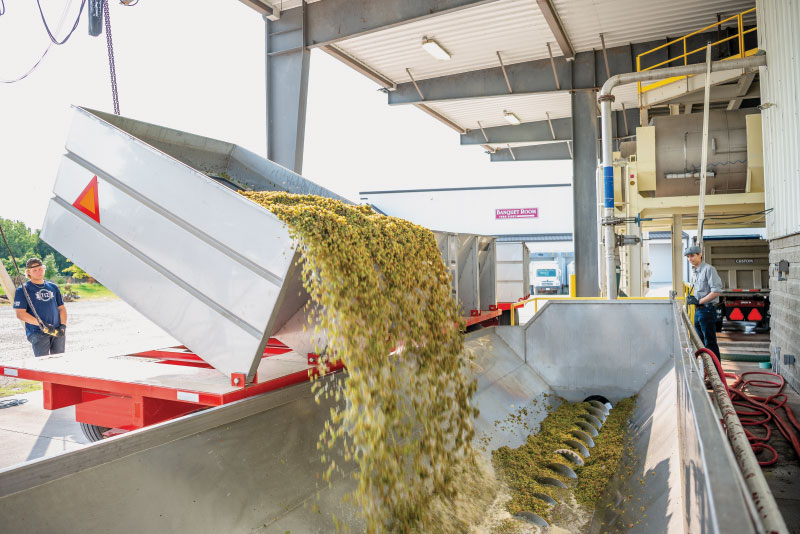
“Harvest turns everybody’s schedules upside down for sure,” said Annemarie Heikenwalder, the winery’s managing director. “Our team gets up at midnight to start work and get the bins filled for the first ferry at 7 a.m. to go to the mainland. We rely on that ferry. Harvest wouldn’t happen without it.”
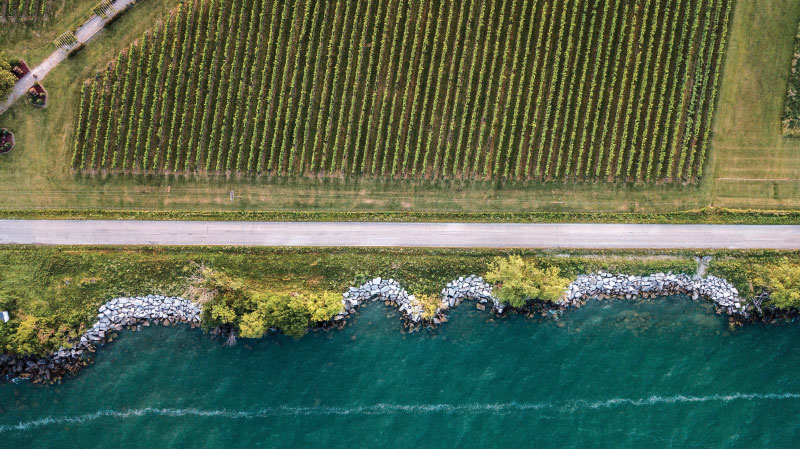
Located 380 kilometres southeast of Toronto, on the western edge of Lake Erie, Pelee Island Winery is located on, in case the winery’s name wasn’t obvious, Pelee Island. The name dates back to the 1700s and likely comes from the French word pelée meaning “bare.” With a year-round population of just 300 people, it is the largest island in Lake Erie and the southernmost populated part of Canada, on the same latitude as northern California and Tuscany, Italy.
The winery itself has roots dating to before Canada was a country, with the first wine grapes being planted on the land in 1854. Canada’s first commercial winery, Vin Villa, was established on the land in 1866, a year before Confederation.
However, it wasn’t until 1979 that the winery’s modern era truly began, when Walter Strehn established Pelee Island Vineyards. The first vintage was released in 1980, and three years later, the tasting room was built on the mainland, in Kingsville, Ont., on the north shore of Lake Erie.
Now, with more than 700 acres of vineyards, the winery is the largest private estate winery in Canada and is owned by a private investor who chooses to stay out of the public eye. With a background in farming and aviation leadership, Heikenwalder came on board in 2023. She now oversees a team of around 65 people, which swells to more than 100 during the summer months.
Walter Schmoranz, Pelee Island Winery’s former winemaker, retired after working with the winery for more than 35 years. Winemaker Danie De Bruyn joined a few months ago. From South Africa, De Bruyn studied oenology in Stellenbosch and has worked at estates around the world, including stints in France and New Zealand, as well as Dunstone Estate in South Africa’s Cape Winelands. At Pelee Island, he and his team are making between 1.8 and two million litres of wine each year; more than 70 wines from more than 40 different grape varieties. Harvest starts early, in mid-August, and typically continues through to the end of October.
The winery is in the process of updating equipment, including the Gregoire harvesters – the grapes are currently all machine-harvested – and adding a cross-flow filter.
Main white varieties include Chardonnay, Pinot Grigio, Riesling, Sauvignon Blanc and Gewurztraminer; main red varieties include Cabernet Franc, Cabernet Sauvignon, Pinot Noir, Merlot and Blaufrankisch, a high-tannin, late-ripening varietal originally from Austria. They have also recently planted Gruner Veltliner, a white grape from Eastern Europe. “It’s growing quite well, and we are expecting a small harvest in the coming year,” Heikenwalder said.
I always say that the winery couldn’t live without the island, and the island couldn’t live without the winery.
Annemarie Heikenwalder, Pelee Island Winery
The semi-sweet Merlot and the Gewurztraminer are big sellers, but the most popular label is the Lola sparkling rosé, which is made from a blend of Vidal blanc and Chambourcin. “It’s my favourite, especially in the summer,” said Heikenwalder.
They also have several low-alcohol wines, in response to a market that has potential and is expanding, she says. Keeping residual sugar levels low is also important for them. “It’s something that is very near and dear to our hearts,” she said, adding that the entire lineup is also vegan-certified. Various wines from the portfolio are for sale across Canada, including Nunavut, Heikenwalder says. They also sell internationally, including in China, the U.S. and Taiwan.
In addition to the typical 750-mL bottle, some wines are offered in 375-mL and magnum bottles. Several are offered in three-litre bags-in-boxes, and the Lola line also comes in 250-mL single-serve aluminum bottles.
Custom labels are a big part of their business; clients appreciate the ability to create labels with their own art for special occasions. These labels are also part of their charitable initiatives. Working with the local humane society, the winery offers customers a chance to get a wine bottle with their pet on the label. “A portion from each sale goes to help rescue animals and to provide support to shelters,” Heikenwalder said.
Giving back is important for everyone at Pelee Island Winery, she says. A portion of all tasting fees goes toward charity and initiatives that benefit the local community. This past August, tasting room donations were donated to Nature Conservancy of Canada’s regional work. The winery is also helping the community with money for improvements for the island’s airport.
“The Ontario government doesn’t consider Pelee Island to be a remote community, but in the winter, there is only aircraft service to get you here,” Heikenwalder said. “And that’s how nurses come to the island to support its residents.”
The winery is the island’s largest employer, she says, and with that comes a responsibility. “I always say that the winery couldn’t live without the island, and the island couldn’t live without the winery,” she said. “Supporting the island is essential. It is a necessary part of our business.”
So is supporting the land. The winery isn’t organic, but does practice sustainability. For example, post-production grape skins are composted on the island. “When you’re farming, you want to give back to the earth as much as you can,” she said. “That balance with nature is something that we feel is very important.”
Being part of Wine Growers Canada has also been a positive experience for the winery, says Heikenwalder. “We do a lot of work with the government and this helps us achieve our goals,” she said. “In farming, our perspective is very much focused on being local, but Wine Growers Canada gives us a considerably broader perspective.”
Although she can’t yet discuss everything happening behind the scenes, there are changes in the works, Heikenwalder says. This season, for instance, they won’t be making icewine, and they may not make it in the coming years. To make icewine, the temperature must drop to -8ºC so the grapes can freeze naturally on the vine. However, if the grapes hang on the vine for too long before freezing, they dry out, along with much of the sweet juice, she says.
“We are seeing later and later colder weather and it just isn’t optimal for the icewine grapes,” she said. Much of what Pelee Island Winery’s visitors, Canadian and international, have come to expect and love at the winery won’t change. They’ll find beauty, calm and nature, whether they visit the year-round tasting room in Kingsville or head over to the island in summer to taste under the grand pavilion.
“Kingsville has such a European flair to it. It’s a beautiful little town with some of the best restaurants I’ve ever eaten at,” Heikenwalder said. “And when you go to the island, there’s this feeling when you get off the ferry and you barely have cellphone reception. All your worries stay behind, and you can really just relax and enjoy the wines and the beauty of nature.”
Expect some fresh new wines to try down the road. “We’re experimenting with some new winemaking styles, but I can’t talk about that yet,” she said. “Ultimately, we plan to continue to produce high quality wines that people seek out and enjoy drinking.”
And, indeed, keep that ferry moving.